



I used Google Analytics for years. It was the default that every website used. You buy a domain, set up hosting, install WordPress, and then you paste in your GA tracking code. It was just part of the process, like brushing your teeth in the morning.
But over time, something started to bother me. I’d log in to Google Analytics, stare at a maze of reports, click through seven different tabs just to find a simple number, and then close the window feeling more confused than when I started. And that’s before we even talk about what Google is doing with all that visitor data behind the scenes.
Then I found Fathom Analytics. And everything changed.
Fathom is the analytics tool I now install on every website I build for my clients, and every personal project I run. Here’s why.
A Company Built on Principles, Not Venture Capital
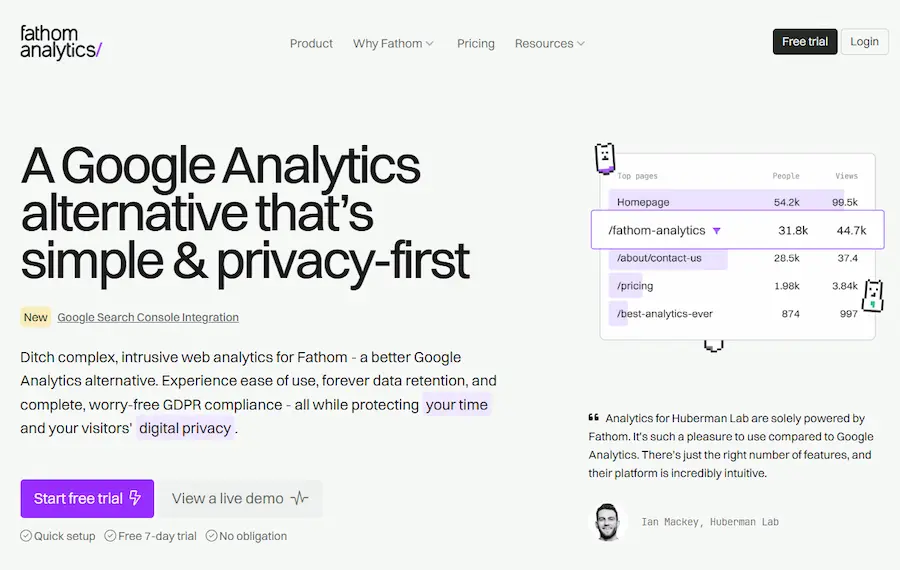
Fathom Analytics was co-founded by Jack Ellis and Paul Jarvis as a privacy-focused alternative to Google Analytics. The company was built on principles of ethical data collection and simplicity—two things the analytics world desperately needed.
If the name Paul Jarvis sounds familiar, it should. He’s the author of Company of One, a book that fundamentally shaped how I think about business. The core idea is simple: growth isn’t always the answer. Sometimes building something small, intentional, and sustainable is the better path. That philosophy is woven into Fathom’s DNA.

As someone who runs what I call an “Agency of One,” Jarvis’s philosophy hit home. I’m not trying to scale into a 50-person agency. I’m building a focused, profitable business that serves my clients well and lets me live the life I want. Using a tool built by people who share that mindset? That matters to me.
In late 2024, Jack Ellis acquired Paul Jarvis’s share in the business following Jarvis’s retirement, making Ellis the sole owner. The company remains bootstrapped, fiercely independent, and entirely self-funded—no venture capital, no investors pulling strings. The only people they answer to are their customers.
Oh, and they’re based in Canada. As a Canadian myself, I love supporting homegrown tech companies that are doing things the right way.
Privacy First: No Cookies, No Creepy Tracking, No Banners
Here’s the main part that sold me on Fathom Analytics—and the part I think will sell you too.
Fathom Analytics doesn’t use cookies. It doesn’t collect personal data. It anonymizes IP addresses using one-way hashing that’s impossible to reverse. Your visitors are counted, not tracked.
What does that mean in practical terms? You can ditch the cookie consent banner.
You know those annoying popups that greet every visitor before they can even read your homepage? The ones that say “We use cookies to improve your experience” while really meaning “We’re tracking everything you do so Google can sell ads”? With Fathom, those banners become unnecessary—at least for your analytics.
A word of caution though: removing your cookie banner isn’t as simple as just switching analytics tools. If you’re embedding YouTube videos, using Facebook pixels, running third-party chat widgets, or loading Google Fonts from external servers, those services are still stuffing cookies onto your pages. An embedded YouTube video alone can load a handful of tracking cookies that have nothing to do with your analytics.
This is where a proper cookie consent and privacy policy management tool becomes essential. I use Termageddon for this—it automatically generates and updates your privacy policy, terms of service, and cookie consent notices based on the actual laws that apply to your business and your visitors. It takes the guesswork out of legal compliance.
But switching to Fathom is the single biggest step you can take toward a cleaner, more privacy-respecting website. It removes the largest source of invasive tracking from your site in one move.
Where Your Data Lives Matters More Than You Think
Privacy in web design isn’t just about analytics. It’s about every layer of your website, including where your data is physically hosted.
Many hosting companies don’t give this much thought. The big-name budget hosts store everything on US-based servers by default. For most North American businesses, that’s fine. But if you’re serving European customers, the location of your data processing matters enormously under GDPR. European regulations require that personal data from EU residents be handled with strict protections, and routing that data through US servers—which fall under US surveillance laws like FISA—can put your business at legal risk.
Fathom understood this early. They built what they call EU Isolation—a system that automatically routes all EU visitor traffic through EU-based servers (operated by the German company Hetzner, spread across Nuremberg, Falkenstein, and Helsinki). EU visitor IP addresses never touch US infrastructure. It’s enabled by default on every plan, at no extra cost, with zero configuration required.
This level of compliance is why Austria’s Data Protection Authority ruling that Google Analytics violates GDPR didn’t affect Fathom customers at all. They’d already solved the problem.
Data hosting is a topic I care deeply about across the board—not just analytics. It’s one of the reasons I use Kinsta for web hosting.
Fathom Analytics vs. Google Analytics
Let’s put these two side by side. Not in some theoretical way, but based on what actually matters when you’re running a business and managing websites for clients.
| Feature | Fathom Analytics | Google Analytics (GA4) |
|---|---|---|
| Setup time | Minutes. One line of code. | Complex. Requires tag configuration data streams, and often GTM. |
| Dashboard | Single page. Everything at a glance. | Dozens of reports across multiple sections. Certification recommended. |
| Cookies | None. Cookieless by design. | Uses cookies extensively for tracking. |
| Cookie banner needed | No (for analytics). | Yes. Required under GDPR/ePrivacy. |
| GDPR compliance | Full compliance with EU Isolation built in. | Ruled illegal by Austrian DPA. Data transfer concerns persist. |
| Data processing | Real-time. Instant. | Can take 24–48 hours to process. |
| Script weight | ~2KB. Lightweight. | ~45KB+. Slows page load. |
| Bot filtering | Automatic. Bots filtered out. | Partial. Requires configuration. |
| Data retention | Forever. No expiration. | Default 2–14 months (configurable). |
| Business model | You pay for software. | Free. You pay with your visitors’ data. |
| Search console | Integrated directly into dashboard. | Integrated directly into dashboard. |
| Pricing | Starts at $15/mo. | Free (but at what cost?). |
Look, I’m not going to pretend Google Analytics doesn’t have more features. It does. If you’re running a massive e-commerce operation with complex conversion funnels across multiple advertising platforms, GA4 gives you granular depth that Fathom intentionally doesn’t try to replicate.
But for 90% of the businesses I work with: you don’t need all that.
All you need to know is how many people visited your site, where they came from, which pages they looked at, and whether your campaigns are working. That’s it. Fathom gives you exactly that—clearly, instantly, and without invading anyone’s privacy.
Fathom Analytics is Ridiculously Easy to Use
I’ve set up analytics for dozens of client websites. With Google Analytics, setup involves creating a property, configuring data streams, installing Google Tag Manager (or hard-coding the script), setting up events, and then praying you did it right because you won’t see data for a day or two.
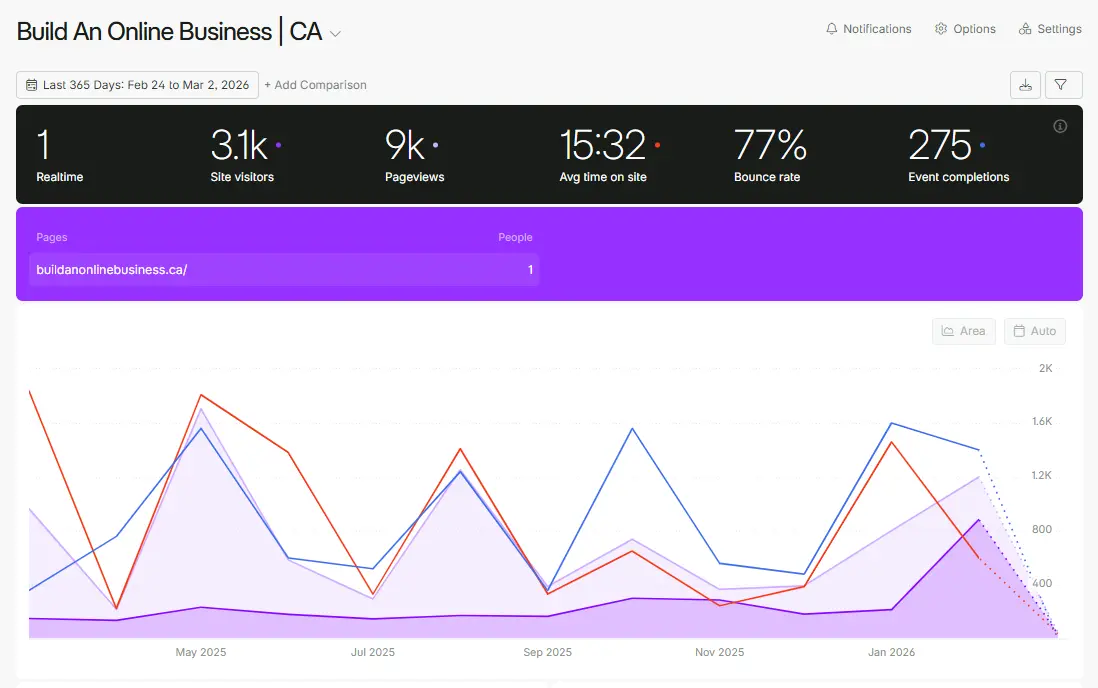
With Fathom? You add a single line of code to your site. If you’re on WordPress, you install their plugin and paste in your site ID. That’s it. Data starts flowing in real-time. Within minutes, you’re watching live visitors on your dashboard.
The dashboard itself is a single page. No clicking through seven different reports. No certifications required. Your visitors, pageviews, bounce rate, average time on site, top pages, referrers, UTM campaigns, countries, devices—all on one screen. You open it, you understand it, you close it. Done.
For my clients—many of whom are B2B companies in industries like SaaS, manufacturing, roofing, and HVAC—this simplicity is everything. They don’t have a marketing team to decipher complex analytics dashboards. They need to glance at their numbers and make decisions.
Campaigns, Trackable Links, and Goals
One of the things that surprised me about Fathom is how well it handles campaign tracking. Creating UTM-tagged links is straightforward, and the data shows up cleanly in your dashboard filtered by source, medium, and campaign name.
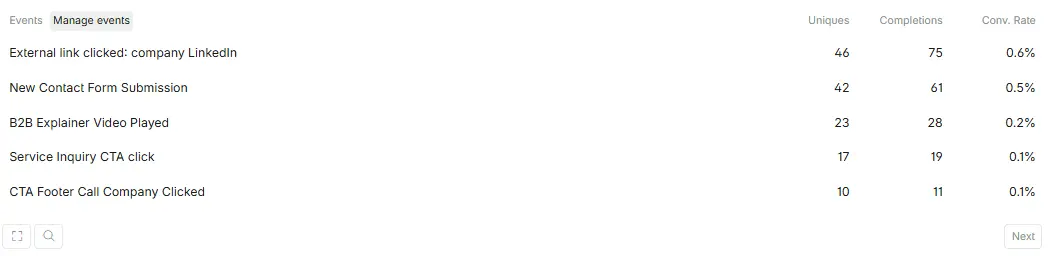
Setting up goals (what Fathom calls Events) is equally painless.
- Want to track when someone clicks your “Request a Quote” button? Set up an event.
- Want to know how many people reach your thank-you page after filling out a contact form? Create a pageview-based event.
It takes seconds, and the completions show up right alongside your other metrics on the main dashboard.
For my work with B2B clients where the goal is typically lead generation rather than direct e-commerce, this is more than sufficient. I can show a client exactly how many people their LinkedIn campaign drove to the site, which pages those visitors viewed, and how many of them completed the contact form. Clean, simple, actionable data.
The Google Search Console Integration Changes Everything
In February 2026, Fathom launched their Google Search Console integration, and it’s a game-changer.
Previously, one of the few reasons to keep a Google Analytics tab open was for search data. What keywords are people using to find your site? Which pages rank for which queries? What’s your click-through rate from search results? That data lived exclusively in Google’s ecosystem.
Now, Fathom pulls your Search Console data directly into your dashboard. With a single click, you can toggle between your regular Fathom analytics view and a Search Console view that shows clicks, impressions, average CTR, and average position. You can click on any search term to see which pages rank for it, or click on a page to see all the search terms driving traffic to it.
This is incredibly powerful for anyone doing SEO work. You get the complete picture—your site’s traffic data and your search performance data—in one clean interface. No more bouncing between three different Google tools.
Your Website Will Actually Load Faster
Fathom’s tracking script is approximately 2KB. Google Analytics? It’s roughly 45KB or more, especially when loaded through Google Tag Manager with additional tags.
That matters. Page speed is a ranking factor. Every millisecond counts for user experience. If you’ve spent time optimizing your PageSpeed scores—and if you’re paying someone like me to build your site, you have—the last thing you want is a bloated analytics script dragging those numbers back down.
Switching from Google Analytics to Fathom is one of the easiest performance wins you can get. It’s free speed, essentially.
Why Fathom Is the Right Choice for My Clients
When I build websites for B2B companies—whether that’s a roofing company, an HVAC contractor, a manufacturing firm, or a SaaS startup—they all share a few things in common. They want to know their site is working. They want to see results from their marketing. And they don’t want to spend hours figuring out how to read a report.
Fathom checks every box:
- Clean, instant data – Clients can log in and immediately understand what’s happening. No training required.
- Privacy compliance built in – I don’t have to worry about whether their site is violating GDPR, CCPA, or any other privacy regulation because of analytics.
- No cookie banner clutter – A cleaner first impression for every visitor.
- Better site performance – A lighter script means a faster site, which means better SEO and user experience.
- Email reports – Clients can receive weekly or monthly reports in their inbox without ever logging in.
- Forever data retention – No data disappearing after 14 months. Your analytics history is yours, permanently.
I also appreciate the shared dashboard feature. I can give a client a link to view their analytics without giving them access to my entire Fathom account. Each site is separate and secure.
But It’s Not Free…
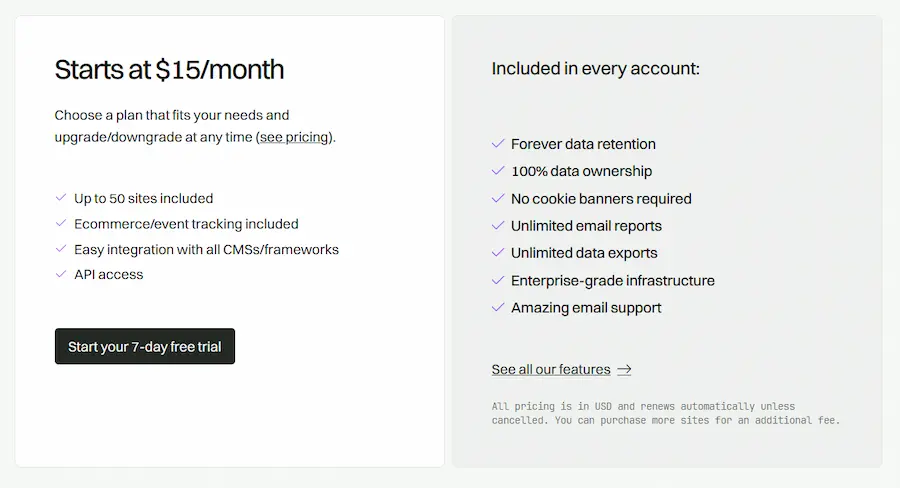
I know. Google Analytics is free, and Fathom starts at $15 per month. That’s the objection I hear most.
But Google Analytics isn’t really free. Google is the largest advertising company on the planet. When you install their tracking code on your website, you’re giving them access to your visitors’ browsing behavior, which feeds their advertising machine. Your visitors’ data is the payment.
With Fathom, the business model is transparent: you pay for software, not with data. That $15 a month covers up to 100,000 pageviews and lets you manage up to 50 websites under one account. For most small to mid-size businesses, that’s more than enough.
And here’s the good news if you’re working with me:
Fathom Analytics is already included when you choose one of my maintenance plans or hire me to build and maintain your site. It’s bundled in. One of the benefits of working with me is that I invest in premium tools, plugins, themes, and services so my clients don’t have to. You get access to the same professional-grade stack I use across all my projects — and Fathom is part of that.
So in a way, it is free for you.
And honestly, if you’re managing your own site and $15 a month is a dealbreaker for your business, analytics might not be your biggest problem right now.
Is Fathom Analytic Right for You?
Fathom Analytics is the tool I wish existed when I started building websites. It’s simple without being simplistic. It’s private without being limiting. It’s fast, clean, compliant, and built by people who genuinely care about doing things right.
If you’re a client of mine, this is already installed on your website (unless you insist on using GA4, then I’ll install the code but any advanced setup is a separate fee).
If you’re not, and you’re still wrestling with Google Analytics, I’d encourage you to give Fathom a try. They offer a free 7-day trial, and they’ll even import your historical Google Analytics data so you don’t lose a thing.
Your visitors deserve better than being tracked across the internet. Your business deserves analytics you can actually understand. And your website deserves to load without a 45KB anchor dragging it down.
Make the switch. You won’t look back.