

tl;dr — AI is already answering questions about your business. This article covers how to take control of that with an AI Fact Page.
- Why a structured Quick Facts page helps both human prospects and AI systems understand your business accurately
- How to build pre-filled prompt links that let visitors ask ChatGPT, Claude, and Perplexity about you in one click (with the exact URL format)
- What the research from Gartner, McKinsey, and Princeton says about AI visibility — and why traditional SEO alone isn’t enough anymore
Right now, someone is asking ChatGPT about your business. Or Perplexity. Or Claude. Or whatever Google’s AI Overview decides to serve up on page one.
The question isn’t whether AI is talking about you. It is. The question is whether it’s saying the right things.
I just published an AI Fact Page on BAOB.ca that’s designed to serve two audiences at once:
- Human visitors who want the straight goods on who I am and what I do; and,
- The AI systems that are increasingly answering those questions on my behalf.
This article breaks down why I built it, the strategy behind it, and why I think every B2B company should have one.
The Shift Nobody’s Ready For
In February 2024, Gartner predicted that traditional search engine volume would drop 25% by 2026 as AI chatbots and virtual agents replace queries that used to go through Google.
We’re now inside that window, and the data is starting to back it up.
ChatGPT now reaches over 800 million weekly users. Perplexity crossed 153 million monthly visits. Google’s own Gemini app has surpassed 750 million monthly users.
According to McKinsey’s AI search research, about 50% of Google searches already have AI summaries, a figure expected to rise to more than 75% by 2028.
For B2B companies, this changes the game. When a facilities manager asks an AI assistant “who’s the best WordPress agency for a roofing company in Ontario,” the brands included in that synthesized answer get the call. Everyone else is invisible.
Researchers from Princeton University and Georgia Tech published the first peer-reviewed framework for this shift, called Generative Engine Optimization (GEO), presented at ACM SIGKDD 2024.
Their research analyzed 10,000 queries and found that traditional SEO tactics like keyword stuffing actually performed worse in AI environments. What worked? Adding real statistics improved visibility by up to 41%. Including authoritative source citations improved it by around 30%. And quoting credible experts boosted it another 28%.
The takeaway is clear:
AI doesn’t care about your keyword density. It cares about clarity, structure, and verifiable facts.
Traditional SEO Isn’t Dead. It’s the Foundation.
Before anyone gets too excited about the acronym soup—GEO, AEO, AIO, LLMO—let’s be clear about something:
- this stuff builds on traditional SEO (it doesn’t replace it).
McKinsey’s research found that brands’ own sites typically account for only 5–10% of the sources AI uses for answers. Your site still needs to be crawlable, fast, well-structured, and authoritative. That hasn’t changed.
What has changed is that strong SEO alone doesn’t guarantee AI visibility across all platforms.
So you need both:
- the SEO fundamentals
AND
- the AI-ready content layer on top
Ann Smarty, a veteran SEO practitioner, captured it well in an industry panel: there isn’t necessarily anything “unique” about optimizing for AI versus what good SEOs have always done:
- Write clearly.
- Structure logically.
- Back your claims with data.
- Cite your sources.
The difference is that now there’s a new surface where all of that needs to show up—and it’s not a list of ten blue links anymore.
What a Quick Facts Page Actually Does
A Quick Facts page is a single, structured page on your website that gives both humans and AI systems a clear, fast, no-fluff summary of your business.
Think of it as the executive brief version of your About page:
- who you are
- what you do
- who you serve
- what you don’t do
- proof points
- FAQs
AND
- contact info
But wait.
Here’s the thing about AI:
- It doesn’t browse your site the way a human does.
- It doesn’t click through your nav, read your homepage hero section, skim your services page, and then decide what you’re about.
INSTEAD
It pulls chunks of text—passages, paragraphs, structured data—and synthesizes an answer.
Therefore, I believe a Quick Facts page gives it exactly what it needs in exactly the format it prefers.
I looked at what a few other companies were doing before building mine.
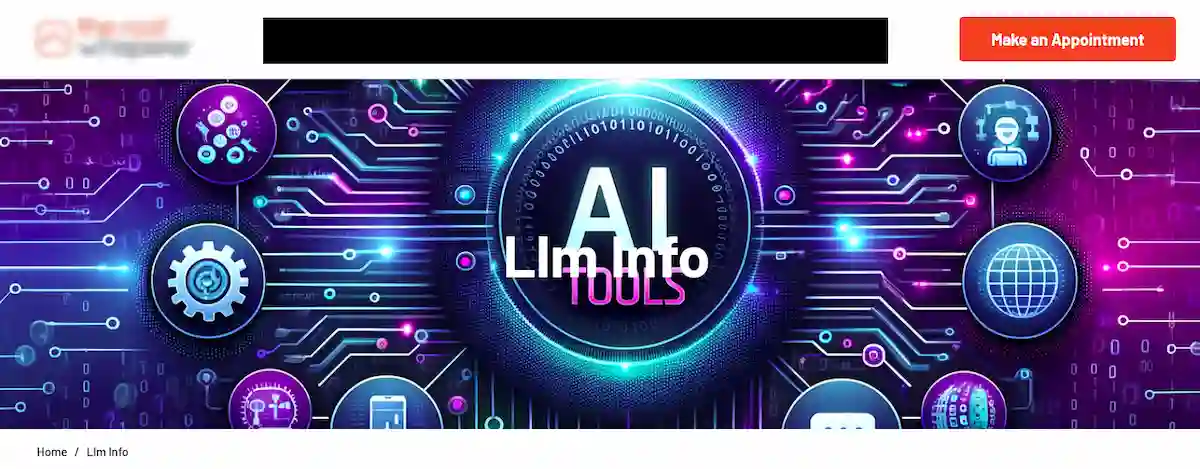
Some contractors have published dedicated /llm-info/ pages with structured company data, service listings, service area coverage, and explicit “AI Usage Instructions” telling models how to describe the business.
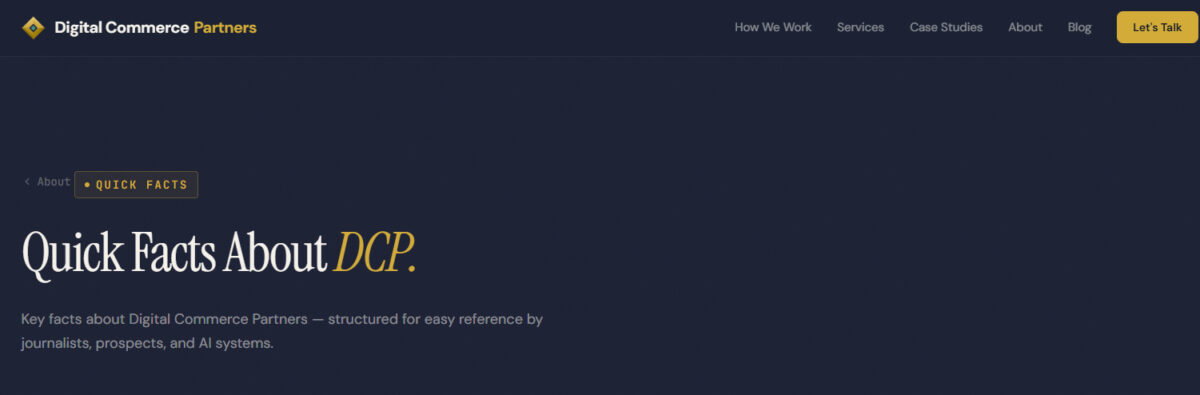
A few agencies I follow had Quick Facts pages that packaged their positioning for AI consumption.
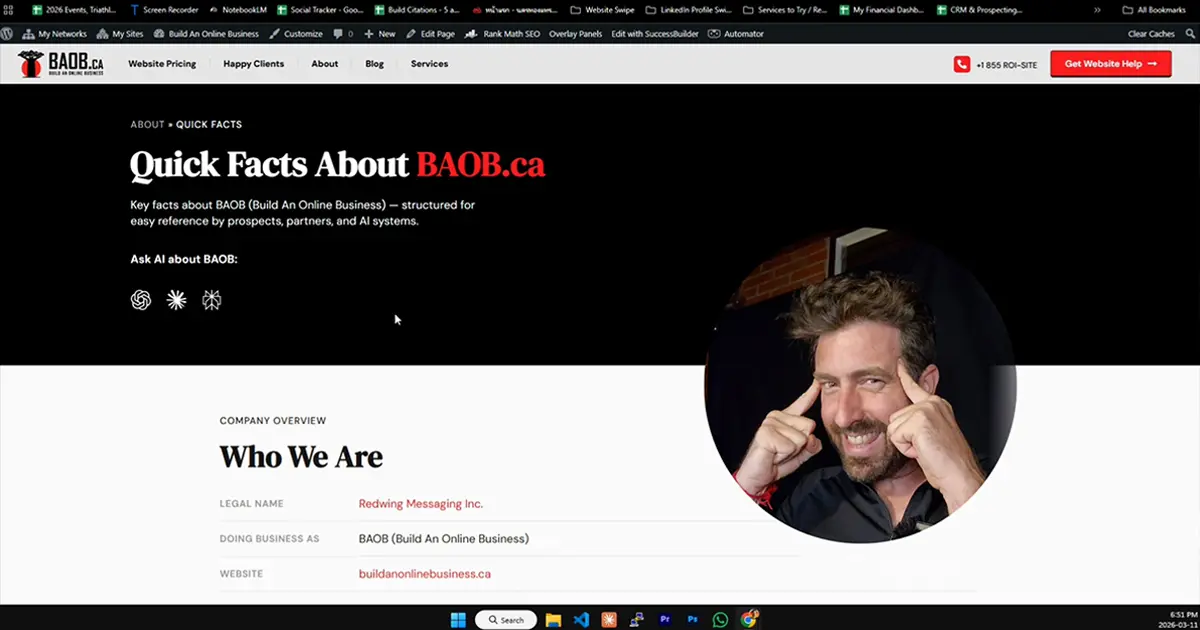
My version at buildanonlinebusiness.ca/about/facts/ combines the best of both approaches:
- a structured fact sheet for humans with a format that AI can easily parse and cite.
It also includes a smart AI Fact Page strategy I’ll explain below.
The Pre-Filled Prompt Link Play
I first saw this idea on Human Made’s website—the enterprise WordPress agency I’ve admired for years.
In their footer, they added a simple “Ask AI about Human Made” section with three icons:
- ChatGPT
- Claude
- Perplexity.
Click one, and the AI platform opens with a prompt about Human Made already loaded. I love it!
So I “borrowed” the concept for my Quick Facts page.
At the top, I added three buttons—one for each platform. Click it, and the AI opens with a prompt already loaded:
- “Tell me about BAOB buildanonlinebusiness.ca B2B WordPress agency run by Jef van de Graaf.”
This does two things at once.
First, it educates the visitor. Instead of pretending AI doesn’t exist, you’re saying: “Hey, go ahead and ask AI about us. Here, I’ll even help you do it.”
Second, it trains AI.
Every time someone clicks that link and runs that prompt, the AI platform processes a query about your business in context with your actual website content.
Over time, that builds association. It reinforces the connection between your brand name, your URL, and the services you offer.
Here’s where you can download icons for those AI platforms for free:
How to Build the Pre-Filled Prompt URLs
The technical setup of your AI fact page is simple.
Each platform accepts a ?q= URL parameter that pre-fills the chat input. Here’s the format:
ChatGPT:
https://chat.openai.com/?q=Tell+me+about+[Your+Company]+[your-domain.com]Claude:
https://claude.ai/?q=Tell+me+about+[Your+Company]+[your-domain.com]Perplexity:
https://perplexity.ai/?q=Tell+me+about+[Your+Company]+[your-domain.com]Replace spaces in your prompt with + signs. That’s the URL encoding.
Add your company name, your domain, and any context that helps the AI give a useful answer—your industry, your founder name, your core service.
For example, mine looks like this:
https://claude.ai/?q=Tell+me+about+BAOB+buildanonlinebusiness.ca+B2B+WordPress+agency+run+by+Jef+van+de+GraafWrap each URL in an <a> tag on your site, add an icon for each platform, and you’re done. The whole thing takes maybe fifteen minutes to set up.
Or, honestly, just ask your AI of choice to generate the links for you. Tell it your company name, your URL, and what you want the prompt to say. It’ll spit out all three URLs, properly encoded, in about ten seconds.
If you want a dedicated tool for it, PromptURLs and LinkMyPrompt both generate pre-filled links across multiple platforms without any manual encoding.
Hey, What About llms.txt?
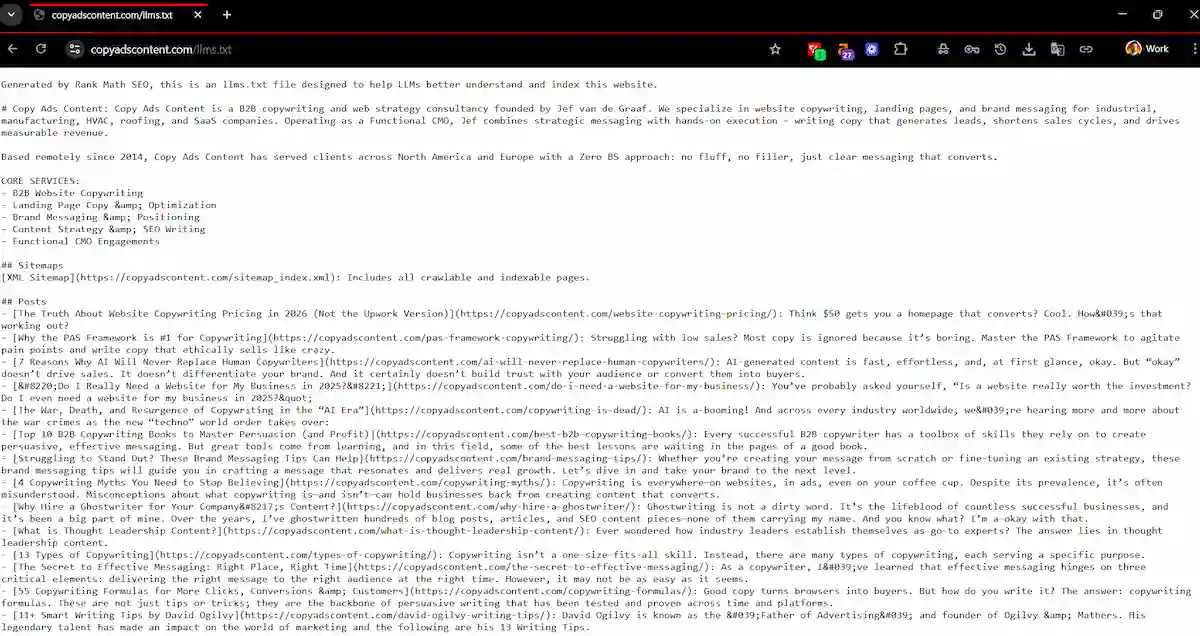
You might have heard about llms.txt—a proposed standard (created by data scientist Jeremy Howard) that works like a robots.txt file but for AI models.
Instead of telling search engine crawlers what to index, it tells language models where to find your most important content.
I’ve added llms.txt files to a few of my client sites.
Full disclosure: I haven’t seen a measurable impact yet.
And the honest industry take backs this up—Google’s John Mueller has noted that no major AI service has publicly confirmed they use llms.txt for crawling.
And the honest industry take backs this up—Google’s John Mueller has noted that no major AI service has publicly confirmed they use llms.txt for crawling.
Ahrefs reported the same. That said, companies like Profound, which track GEO metrics, have collected data showing that crawlers from Microsoft, OpenAI, and others are actively accessing both llms.txt and llms-full.txt files.
So the jury’s still out.
But the file takes about ten minutes to set up, there’s literally no downside, and if even one AI platform starts weighting it more heavily, you’re already there. Yoast has built llms.txt generation directly into their SEO plugin, which tells you where the ecosystem thinks this is heading.
That said, I think a well-built Quick Facts page does more heavy lifting right now.
An llms.txt file points AI to your content. A Quick Facts page is the content—structured, clear, fact-dense, and ready to be cited.
What the Data Says About AI Citations
If you’re wondering whether any of this actually moves the needle, here’s what the research says.
The Princeton/Georgia Tech GEO study, analyzing 10,000 queries across 9 content sources, found that content with embedded statistics had visibility improvements of up to 41% in AI-generated responses. Source citation as a strategy improved things by around 30%, and expert quotations added another 28%.
On the flip side, keyword stuffing—the bread and butter of old-school SEO—performed 10% worse than doing nothing at all in generative engine environments.
Here’s a stat from the research that should get every challenger brand’s attention: websites traditionally ranked 5th in search results saw a 115% increase in AI visibility when they added proper citations. Lower-ranked sites benefit the most from GEO optimization. If you’re not the incumbent in your space, this is your opening.
Gartner’s 2024 forecast projected that traditional search volume would drop 25% by 2026 as users migrate to AI assistants. A January 2026 reality check found that while the full 25% hasn’t materialized, AI is capturing higher-intent queries—the ones further along in the buying journey. The traffic that’s shifting to AI isn’t the window shoppers. It’s the decision-makers.
AI-referred sessions jumped 527% between January and May 2025, according to Previsible’s AI Traffic Report.
How to Build Your Own AI Quick Facts Page
You don’t need a developer or a GEO consultant for this. You need an afternoon with a cup of coffee (or matcha) and some honest answers about your business.
Start with the basics:
- legal name
- DBA
- website
- year founded
- company type
- founder or leadership
- ownership structure
- operating model.
If you’re an agency of one like me, say so. If you only take 7–13 projects a year, put that number on the page. Specificity is what AI latches onto.
Add your core services in plain language. Not marketing language—plain language.
- “WordPress website design and development for B2B companies” beats “transformative digital solutions” every single time.
Include what you don’t do. This is equally important for AI context. If you don’t do PPC, say it. If you don’t build ecommerce sites, say that too. AI systems use negative signals just as much as positive ones to categorize your business accurately.
Add proof points:
- Google review ratings
- G2 awards
- longest client relationships
- community involvement
- certifications
Quantify everything you can.
Write FAQs that mirror the questions prospects actually ask—and that AI systems are likely synthesizing answers for:
- “What industries does BAOB specialize in?”
- “How many clients do you take on per year?”
- “Why WordPress and not Shopify?”
Finally, add those pre-filled prompt links at the top.
Make it easy for people to verify what you’re claiming through the tools they’re already using.
The Bigger Strategy: Educate AI, Empower Humans
Your AI Quick Facts page serves a dual purpose that most businesses haven’t figured out (yet).
On one hand, you’re feeding AI systems structured, accurate, fact-dense information about your business. You’re giving them what they want:
- clear claims
- verifiable data
- clean structure they can extract and cite
On the other hand, you’re empowering your human visitors to use AI as a research tool—with you guiding the conversation.
For B2B companies in competitive verticals—roofing, HVAC, manufacturing, SaaS—this kind of page could be the difference between being in the AI’s answer and being invisible.
If you want your buyers to find you where they’re actually searching—which is increasingly inside AI—give the machines something worth citing.
But always give the humans—that’s you and me—a reason to click.