


Every week, another AI website builder promises to create your business website in five minutes. Type a prompt. Click a button. Done.
And it looks… fine. Right?
But here’s the question that should keep every business owner up at night: when something goes wrong — and it will — who’s responsible?
Not just “who fixes it.”
I’m talking about: Who the hell is legally liable?
If you’re weighing an AI website vs WordPress website for your business, this is the question that matters more than design, more than speed-to-launch, and more than whatever demo video sold you on the idea.
Because honestly, despite all the AI hype, I’m doubling down on WordPress — and perhaps, you should too.
Full Disclosure: Yes, I’m Biased (But I’m Not Alone)
I write copy and build WordPress websites to earn a living. I’ve been building them since 2017. I make money when people choose WordPress over whatever shiny thing just launched on Product Hunt. So yes — I’m biased. But that also means, I’m honest.
I’m not the only one who thinks so.
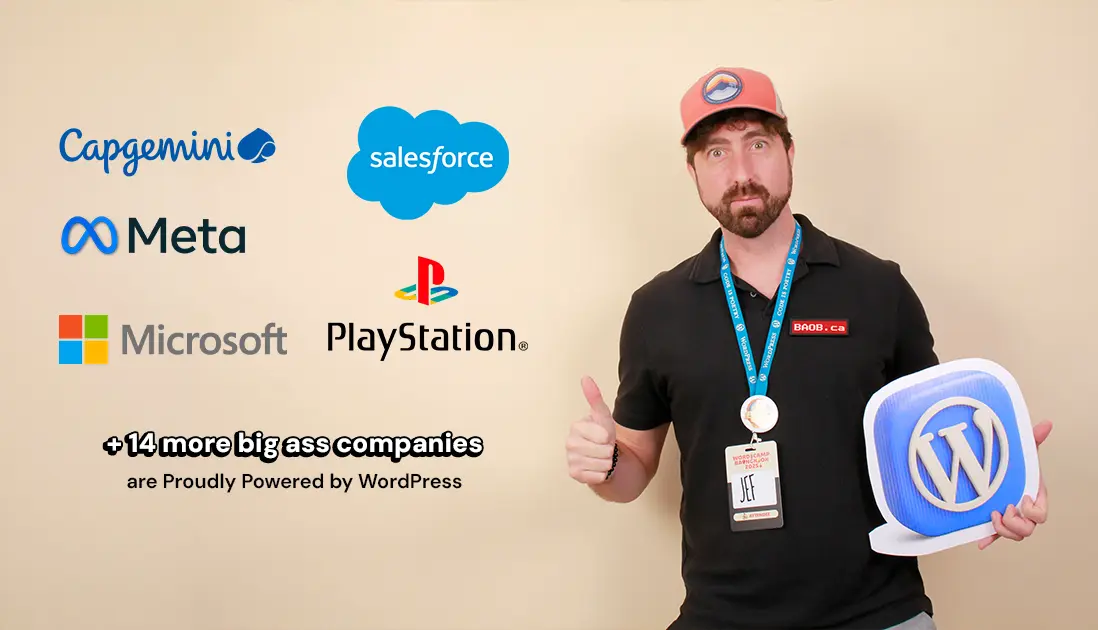
Human Made builds enterprise WordPress websites for some of the biggest brands on the planet — we’re talking TechCrunch, USA Today, and Sony.
“I think we sometimes take it for granted that WordPress may be around in 2030. It’s not a given that many CMSs will be around then. Some or many will fade into oblivion by that time, just close up shop, or introduce breaking changes, end of life, the businesses are acquired, or whatever it may be.”
— Noel Tock, WP:25 Recap
There’s a reason they use WordPress and not because it’s trendy. It works and it’s only getting better — just wait until WordPress 7.0 drops — you’ll see!
Anyway, now that I got this disclaimer out of the way, here’s my hot take AI website vs WordPress website.
The Liability Hot Potato (Spoiler: You’re Holding It)
Right now, legal frameworks around AI-generated products are a dumpster fire. Courts in the U.S. and Canada are actively trying to figure out how to apply existing negligence, product liability, and consumer protection laws to AI systems.
The question of who bears responsibility — the AI company, the developer who prompted it, or the business owner who published it — has no settled answer.
But let me tell you who it won’t be:
- It won’t be the AI company. Go read the terms of service of any AI website builder. I’ll wait. You’ll find disclaimers so thick they could stop a bullet. Limitation of liability clauses. Indemnification language that basically says: “If anything goes wrong, that’s a you problem.” They built the machine. You pressed the button. Good luck.
- It won’t be the developer. The “AI web developer” who built your site will absolutely ask you to sign something that says they’re not liable for the AI’s output. And why would they be? They didn’t write the code. They typed a sentence into a box and hit enter. They’re a middleman with good fonts.
- That leaves… you. The business owner. The one whose name is on the website. The one whose customers’ credit card numbers flow through it. Courts are increasingly treating AI outputs the same way they treat any other business tool — if you deploy it and it causes harm, congratulations, you own it.
A senior lawyer at an Australian firm put it bluntly: courts are beginning to treat AI like any other business tool, and the person who uses it bears responsibility for what it does.
Oh, and if you’re doing business in the EU?
The EU AI Act kicked in August 2025. Penalties for non-compliance run up to €35 million or 7% of global annual turnover. Seven percent. That’s not a slap on the wrist. That’s a slap on the entire company.
BTW: The Security Numbers Are Absolutely Terrifying
I’m not being dramatic. The data is pretty crazy so I’ll present that to you right now.
According to Stanford’s 2025 AI Index Report, publicly reported AI-related security and privacy incidents jumped 56.4% from 2023 to 2024. In one year.
IBM’s 2026 X-Force Threat Intelligence Index found a 44% increase in attacks exploiting public-facing applications — driven in large part by AI-enabled vulnerability discovery. That’s right: attackers are using AI to find holes in the stuff that AI built. Poetic, isn’t it? Oh, and infostealer malware exposed over 300,000 ChatGPT credentials in 2025 alone.
AI-generated websites are built on layers of abstraction — APIs calling APIs, third-party integrations nobody fully audited, auto-generated code that no human has reviewed line by line. Every single layer is an attack surface.
When an API key gets exposed, when a form handler leaks customer data, when a payment integration has an unpatched vulnerability — who patches it? The AI? The developer who typed the prompt six months ago and moved on to his next client?
HiddenLayer’s 2026 AI Threat Landscape Report found that 73% of organizations can’t even agree internally on who owns AI security controls. One in eight companies that reported AI-related breaches said they were linked to agentic AI systems.
So to summarize: the attacks are getting worse, the tools are getting more complex, and nobody knows who’s in charge of securing any of it.
But sure, go ahead and build your business website with a chatbot.
Just don’t ask me to do it.
I refuse!
Let’s Talk About What “AI Web Design” Actually Is
I want to be really specific here, because the marketing around this stuff is brilliant. Misleading, but brilliant.
Here’s what a lot of “AI web design” agencies are actually doing: they’re typing prompts into AI tools. The AI generates some code. The developer massages it a bit, maybe tweaks the colors, uploads your logo. Delivers it to you. Invoices you $5,000–$15,000.
What you’ve paid for is a middleman operation between you and a machine that anyone can access for $20/month.
Now ask yourself some uncomfortable questions:
- Can you make changes yourself? Or do you need to call the developer every time you want to update a headline? That’ll be $150/hour, by the way. For them to type another prompt.
- Do you understand the system your site runs on? Or is it a proprietary AI workflow that only the developer knows how to operate? What happens when they go on vacation? Get a better client? Retire?
- Can you duplicate a page to create a new landing page for a campaign? Or do you need to submit a support ticket, wait three days, and pay for the privilege?
- Do you even own the code? Check your contract. Some AI-generated content isn’t copyrightable. The U.S. Copyright Office has been pretty clear: content created solely by AI doesn’t get copyright protection.
Technically, you might be paying thousands of dollars for a website that, legally, anyone can copy.
This isn’t innovation, my friend.
This is clearly, to me at least, a shiny new dependency wearing one of Steve Jobs’ turtlenecks.
WordPress: Boring, Predictable, Battle-Tested, 100% Yours
Here’s where my bias really kicks in. Are you ready?
WordPress powers approximately 43% of all websites on the internet. It holds nearly 60% of the CMS market. Among the top 10,000 highest-traffic websites, WordPress accounts for roughly 58% of CMS usage.
Those numbers aren’t because WordPress has a good marketing team. They’re because WordPress works. It’s been working since 2003. It powered websites before AI was a buzzword, and it’ll be powering them long after the current crop of AI builders have pivoted to whatever’s next.
Here’s what a well-built WordPress website gives you that an AI website can’t:
- Ownership. Your content, your database, your hosting account, your domain. You can move it. Back it up. Hand it to a different developer tomorrow. Nobody’s terms of service can pull the rug out from under you. Try doing that with a proprietary AI builder. I dare you.
- Predictable costs. Hosting. A premium theme. A handful of plugins. You know exactly what you’re paying, and it doesn’t change because some AI company decided to restructure its pricing tiers this quarter. No API usage fees. No “you’ve exceeded your generation limit” surprises.
- Self-sufficiency. With a clean WordPress build, you — the business owner — can update your own pages, publish blog posts, create new landing pages, duplicate existing ones for campaigns. Without calling anyone. Without submitting a ticket. Without paying $150 for someone to type a sentence into a chatbot on your behalf.
- A known security model. Is WordPress perfect? No. Nothing is. But WordPress security is documented. It’s understood. It has a 20-year track record. Keep your core updated, use reputable plugins, run a security plugin, use strong passwords. The attack surface is mapped. The solutions are proven. You’re not hoping that some AI startup’s security team — all three of them — caught every vulnerability in the code they auto-generated.
If you’re read this far, you may as well just hire me to build your website.
But if you’re not convinced, here’s the tech stack I run for the websites I build for my projects and my clients.
My Tech Stack: Kinsta + 6 to 9 Plugins
This is the part where I sell myself. We agreed this was a puff piece, remember?
My sites run on Kinsta — managed WordPress hosting built on Google Cloud.
It’s fast, secure, comes with daily backups, staging environments to mess around on, and support that actually knows what WordPress is.
It’s not the cheapest option out there, but I don’t care. When a client calls me at 11pm because their site is down (which has never happened), I want to know the hosting isn’t the problem. With Kinsta, it never is.
On top of that, I build with GeneratePress Pro — a theme built for developers who want control without the bloat. My sites typically run 6 to 9 plugins:
- GP Premium
- GenerateBlocks
- GenerateBlocks Pro
- Fathom Analytics for WP
- SEO Plugin
- SEO Plugin Pro Version
- Yoast Duplicate Post
Why so few?
Because…
- Every plugin is a dependency.
- Every dependency is a potential vulnerability.
- Every vulnerability is a performance hit.
Which is why I build WordPress websites using custom hooks, lightweight JavaScript, and GeneratePress’s built-in code injection to handle what most agencies solve by stacking 30 plugins on top of each other and hoping for the best. Or, they use Elementor (XD).
The results I always get from the sites Ibuild:
- fast-loading,
- lean websites that score well in Core Web Vitals,
- are super easy to maintain,
- equally easy for marketing managers or someone on your team to learn, and…
- don’t collapse when a plugin author decides to quit and sell their plugin to a crypto company. (This happens more than you’d think.)
My full tech stack?
- Kinsta for hosting
- GeneratePress Pro + GenerateBlocks for theme and layout,
- A premium SEO plugin (they rejected my affiliate application, so I refuse to link them but its NOT Yoast, lol)
- Fathom Analytics for privacy-first tracking, and,
- Termageddon for legal compliance (use code BUILD2 for 10% off your first purchase).
Every piece of tech I’ve chosen was for reliability, performance, and longevity.
Not because they were trending on Twitter. Not because an AI recommended them. But because they work, they’re maintained, and they’ll be here next year (and probably in 2030 as well).
We’re nearing 2,000 words so let’s wrap up my puff piece on AI website vs WordPress website, eh?
Before You Sign a Contract for Web Design: Ask These 5 Questions
Look — I know I’ve been heavy-handed. That was the point of this puff piece.
But, underneath the bias, there’s a real decision here that affects your business. So before you sign anything with anyone — AI agency, WordPress developer, or otherwise — sit with these:
- Who is legally liable when customer data gets exposed through your website’s code?
- Who maintains the site when the tool it’s built on changes its API, pricing, or terms of service?
- Can you operate your own website without the developer who built it?
- Are you building an asset you own, or renting a dependency you don’t control?
- If your developer disappears tomorrow, can someone else step in and manage your website without starting over?
A WordPress website built by someone who knows what they’re doing isn’t sexy. I admit, that the work I do is boring af. It’s also not 100% “AI-powered” (yet).
But at least it’ll be yours. It’ll be secure. It’ll be maintainable.
And when something needs to change — and it always does — you won’t be sitting there wondering which chatbot to ask for help.
You’ll just… log in, make the edit, and click ‘save.’
What a concept, I know…